


What is workplace negligence? It may arise when an employer fails to take reasonable care for a worker’s safety, and that breach of duty causes or materially contributes to an injury or illness.
In Victoria, a workplace injury does not automatically establish employer negligence or a right to common law damages.
WorkCover benefits and workplace negligence are separate issues. A worker may qualify for WorkCover without proving employer negligence, while a common law claim has additional requirements.
For injured workers across Melbourne, including West Melbourne, this guide explains the main legal concepts, how negligence differs from WorkCover eligibility and when legal advice may help.
Workplace Negligence: A Plain-English Definition
Workplace negligence concerns whether an employer failed to take reasonable care in the circumstances and whether that failure caused or materially contributed to the worker’s injury or illness.
Victorian employers have specific statutory duties under the Occupational Health and Safety Act 2004 (Vic).
These include providing and maintaining a working environment that is safe and without risks to health, so far as is reasonably practicable. Employers must also provide suitable information, instruction, training and supervision.
An accident at work does not, by itself, prove a breach of duty. The circumstances matter, including what the employer knew or should reasonably have known, the foreseeable risk, available safeguards and the link between the alleged failure and the injury.
Why the Facts of Each Workplace Incident Matter
Every workplace incident needs to be assessed on its own facts. A lawyer will consider workplace conditions, safety systems, training records, incident reports, witness accounts and medical evidence when assessing a negligence claim.
Four Elements That May Need to Be Shown
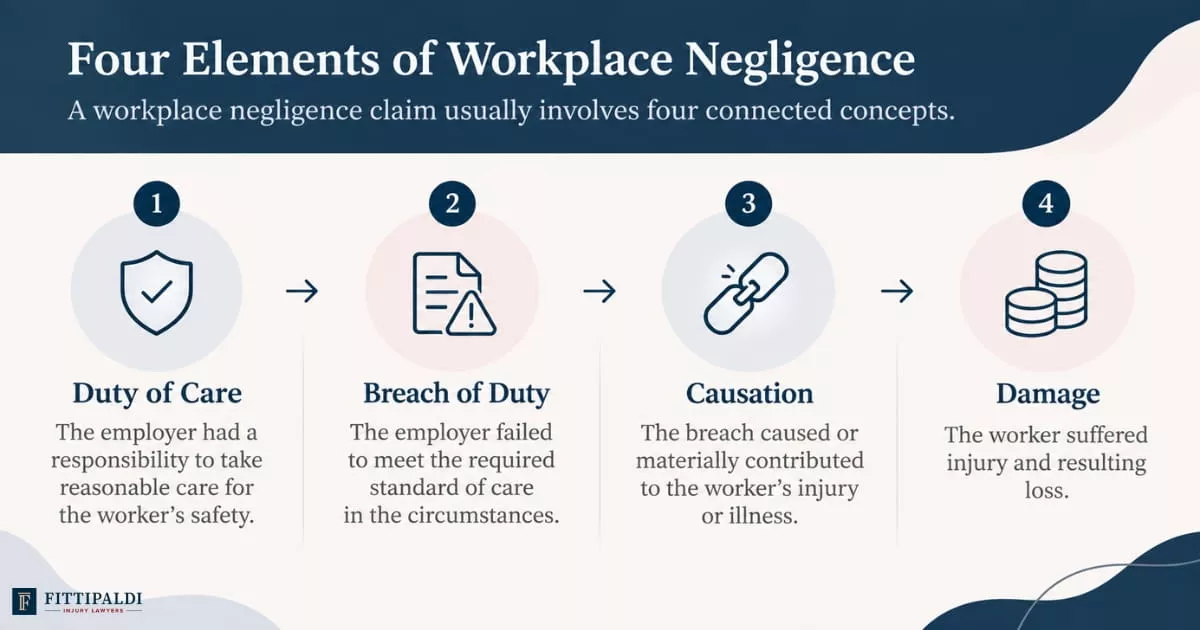
A workplace negligence claim usually involves four connected concepts:
- Duty of care: The employer had a responsibility to take reasonable care for the worker’s safety.
- Breach of duty: The employer failed to meet the required standard of care.
- Causation: The breach caused or materially contributed to the injury or illness.
- Damage: The worker suffered injury, resulting in loss.
These elements need to be considered together. An injury occurring at work does not, by itself, establish employer negligence or entitlement to common law damages.
Duty of Care and Breach
An employer’s duty may include taking reasonable steps to provide safe equipment, appropriate instruction, suitable supervision and a safe system of work.
A breach may occur when an employer falls below the required standard of care in the circumstances. Not every workplace mistake or accident amounts to negligence.
Causation and Loss
Causation asks whether the alleged breach caused or materially contributed to the worker’s injury or illness. The connection between the employer’s conduct and the harm must be supported by the facts and evidence.
Damage refers to the injury and resulting loss. Depending on the claim, this may include pain and suffering and economic loss, such as loss of earnings for past and future.
Examples of Conduct That May Be Negligent
The following are hypothetical examples only, not actual client cases. Whether similar conduct amounts to negligence depends on the facts, evidence and reasonable precautions available.
Unsafe Equipment and Uncontrolled Hazards
A worker might be required to use damaged lifting equipment after repeated fault reports. If the equipment fails and causes a serious injury, those reports may help show whether the employer knew about the risk and whether reasonable steps were available.
Another example could involve a known spill or exposed edge left without a suitable barrier, warning or clean-up. A hazard alone does not establish negligence. The employer’s knowledge, response and available safety measures also matter.
Inadequate Training or Unsafe Systems of Work
A new employee might receive inadequate practical training before performing duties. If unclear instructions contribute to an injury, the training provided may be relevant to whether the employer took reasonable care.
An unsafe system of work may also arise where workers are being asked to perform duties in a hazardous manner or without adequate equipment or assistance. This creates a foreseeable risk of injury that is not adequately controlled. Whether this amounts to negligence depends on the circumstances and evidence.
WorkCover Benefits and Common Law Damages Are Different
Victorian WorkCover benefits and common law damages are separate pathways with different requirements.
WorkCover benefits may be available for an accepted workplace injury without requiring the worker to prove employer negligence. Depending on eligibility and scheme rules, benefits can include weekly payments, medical expenses and other statutory entitlements.
A common law claim is different. It generally involves proving employer negligence, satisfying the applicable serious injury requirements and establishing the relevant loss.
If you have suffered a workplace injury due to workplace negligence, read our guide to making a WorkCover claim in Melbourne.
You can also read our guide to WorkCover compensation options in Victoria, including support for serious injury and psychological injury claims.
When Common Law Damages May Be Relevant
In Victoria, a worker generally needs a serious injury certificate or a court determination before pursuing common law damages.
The Workplace Injury Rehabilitation and Compensation Act 2013 (Vic) sets out requirements that apply to these claims.
WorkSafe Victoria also provides information about common law claims.
Eligibility, procedural requirements and the limitation period can depend on the circumstances. Contributory negligence may also need to be considered where the worker’s own conduct is alleged to have contributed to the injury.
These issues should be checked against the current law and the circumstances of the individual claim.
Evidence That Can Help Explain What Happened

Preserving evidence can help create a clear record of the workplace incident. You do not need to investigate your employer yourself.
Keep copies of documents you can lawfully access and record important details while they are fresh.
Useful Records After a Workplace Injury
Depending on the circumstances, useful records may include:
- Incident reports and photographs or videos you can lawfully obtain
- Witness statements or details of people who saw what happened
- Rosters and training records
- Equipment and maintenance records
- Emails, messages and other workplace safety communications
- Medical certificates and treatment records
- A dated personal record of the incident, symptoms and work restrictions
These records may help establish what happened, what the employer knew or should have known, and how the injury developed.
Why Early Records Can Be Important
Early records may help show whether a risk was foreseeable, whether safety measures were in place and whether an alleged breach caused or materially contributed to the injury.
Missing evidence does not automatically prevent a potential claim, but it does make it harder.
What Should I Do Next?
- Report the workplace injury through the appropriate workplace process.
- Seek medical attention and keep your medical records.
- Keep copies of incident reports and other records you can lawfully access.
- Write down what happened while the details are still fresh.
- Avoid altering the incident scene or accessing confidential workplace records.
- Consider legal advice if you are unsure about your WorkCover rights or possible common law claim.
When to Seek Legal Advice in Melbourne
Consider seeking legal advice if you have suffered a serious injury, your symptoms continue, or you are unsure whether your circumstances involve WorkCover or possible common law damages.
Early advice can help you understand your options, identify useful evidence and check relevant deadlines. You may also want advice if your account of the workplace incident is disputed or you receive formal correspondence you do not understand.
What Clear Legal Guidance Should Cover
- What happened and how the workplace injury occurred
- The available medical and workplace evidence
- Your WorkCover position and possible common law issues
- Any serious injury requirements that may apply
- Relevant deadlines and the limitation period
- The likely next steps, explained in plain English
Fittipaldi Injury Lawyers provides direct access to the solicitor handling the matter, along with personalised and transparent guidance.
FAQs
What is considered employer negligence?
Employer negligence may involve failing to take reasonable care for workers’ safety when a foreseeable risk could reasonably have been managed.
Examples may include unsafe equipment, inadequate training or an unsafe system of work. Whether conduct amounts to negligence depends on the facts, evidence and applicable law.
What are the four proofs of negligence?
The four commonly discussed elements are duty of care, breach of duty, causation and damage.
A worker generally needs to establish the relevant connection between the alleged breach and the injury or loss. Requirements can differ depending on the type of claim.
How do you prove employer negligence?
Evidence may include an incident report, witness statements, photographs, training records, maintenance records, workplace communications and medical documents.
These records may help establish what happened, what the employer knew or should have known, and whether the alleged breach caused or materially contributed to the injury.
How much is a negligence lawsuit worth?
There is no standard amount for a workplace negligence claim. The potential value of a qualifying common law claim depends on the injury, whether negligence can be established, the losses suffered and the available evidence.
A lawyer can assess your circumstances and explain whether a potential common law claim may be available.
Key Takeaway
Workplace negligence involves more than an accident happening at work. It generally requires a duty of care, breach, causation and resulting damage.
WorkCover benefits and common law damages are separate pathways with different requirements. Your options depend on your injury, evidence and circumstances.
If you are unsure about your legal options after a workplace injury, speak with our WorkCover lawyers in Melbourne.
This article provides general information only and is not legal advice. Your rights and options depend on your individual circumstances and the law that applies to your claim.