


WorkCover payments after 130 weeks in Victoria do not stop automatically, but keeping them depends on meeting specific eligibility rules. This guide explains the 130-week review and the 21% whole person impairment rule.
Who Can Continue Receiving WorkCover Payments After 130 Weeks in Victoria?
Workers who meet the eligibility requirements for ongoing weekly payments may continue receiving WorkCover payments after 130 weeks in Victoria. This includes workers with no current work capacity and those who have returned to work part-time, provided they meet the criteria for their situation.
For claims that reach 130 weeks on or after 31 March 2024, workers with no current work capacity must meet two requirements:
- Have no current work capacity and that incapacity is likely to continue indefinitely, and
- Have a permanent whole person impairment (WPI) of 21% or more.
The 130 weeks includes the first 13 weeks of payments and the 117-week second entitlement period.
Workers who have returned to work part-time may qualify under a separate pathway. This has additional work and earnings requirements, alongside the 21% WPI threshold.
The table below compares the eligibility requirements for both pathways.
| Your situation | What you need to keep receiving payments |
| No current work capacity | No capacity for any work likely to continue indefinitely, plus a permanent WPI of 21% or more |
| Partial return to work | At least 15 hours of work a week, earnings above the indexed weekly minimum, unlikely to be able to earn more because of your injury, plus a permanent WPI of 21% or more |
What Is the 130-Week WorkCover Review?
Victoria’s WorkCover scheme includes a 130-week review that decides whether your weekly payments continue. Section 163 of the Workplace Injury Rehabilitation and Compensation Act 2013 requires a review. Your WorkSafe agent carries it out as your claim nears 130 weeks.
The agent looks at your capacity for work and your WPI. This can include independent medical opinions and an assessment by an independent impairment assessor.
The review also checks if your incapacity is still materially attributed to the accepted injuries. If your injury is a temporary aggravation of underlying conditions, the agent checks whether its effects have ended.
When Does the Review Start?
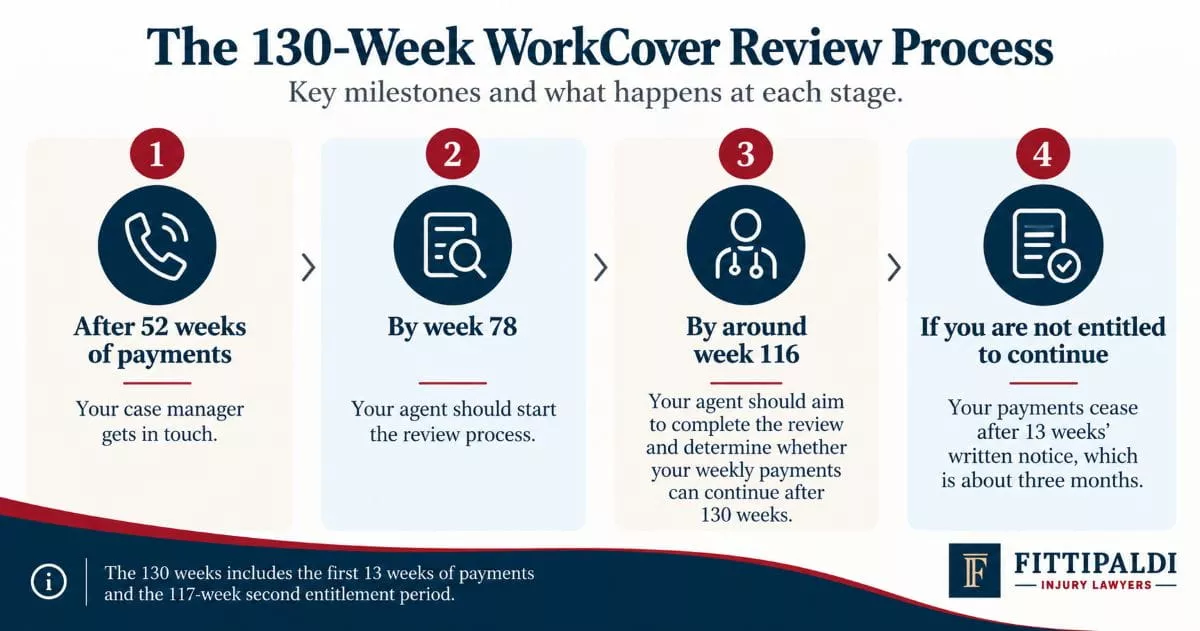
- After 52 weeks of payments: Your case manager gets in touch.
- By week 78: Your agent should start the review process.
- By around week 116: Your agent should aim to complete the review and determine whether your weekly payments can continue after 130 weeks.
- If you are not entitled to continue: Your payments cease after 13 weeks’ written notice, which is about three months.
What Is the 21% Whole Person Impairment Requirement?
Whole person impairment (WPI) is a percentage rating of the permanent effect of your injury.
A rating below 21% WPI means you do not meet the main test for weekly payments of compensation after 130 weeks, even if you cannot work.
An independent impairment assessor carries out the assessment in accordance with the American Medical Association (AMA) Guidelines to the Evaluation of Permanent Impairment.
If you have a mental injury, the assessor uses the Guide to the Evaluation of Psychiatric Impairment for Clinicians (GEPIC) to measure psychiatric impairment.
Your WPI assessment considers the permanent effects of your accepted work-related injuries. Physical and eligible primary psychiatric impairments are evaluated separately. For the 130-week review, the higher percentage between the two impairment ratings is used.
Can You Still Receive WorkCover Payments If You Return to Work Part-Time?
Yes, ongoing partial payments may be available. You can apply to keep receiving weekly payments after a partial return to work. WorkSafe approves the application only if you meet every criterion listed earlier, including the impairment rating.
Your current earnings change the amount of your potential weekly payments. These are calculated as 80% of your pre-injury average weekly earnings, minus 80% of what you earn now. They are also subject to a statutory maximum.
Pre-injury average weekly earnings are usually the average of your ordinary earnings over the 52 weeks before your injury.
Your agent may ask your employer to confirm the hours you work and your weekly earnings. They may also ask whether your employer can offer more hours.
Can WorkCover Stop Your Payments at 130 Weeks?
Yes, if you no longer meet the criteria for ongoing payments. But your agent cannot simply stop them. It must complete the 130-week review process, then give you written notice. The notice must state its reasons and the date your payments will stop.
What Should You Do If Your Payments Are Being Stopped?

- Read the notice closely. Check the reasons stated for stopping your payments.
- Note the key dates. Write down when payments stop and any deadlines in the notice.
- Keep your medical evidence. Hold on to your medical reports and certificates of capacity.
- Check the findings. Look at the evidence the review considered and the result it reached on your capacity and impairment rating.
- Get legal advice early. Time limits can apply to challenging a decision, so speak with our WorkCover lawyers in Melbourne before you respond.
If you disagree with the decision, you have options. A Medical Panel can decide medical questions if you only dispute your impairment rating. Other disputes can go to internal review or conciliation.
Does Reaching 130 Weeks Affect Other WorkCover Entitlements?
WorkSafe Victoria’s guidance on weekly payments sets out how the 130-week review decides whether those payments continue or not. Other parts of your claim follow their own rules:
- Treatment expenses
- A permanent impairment benefit
- Common law damages
- Weekly payments after surgery, which you can apply for if you are incapacitated and meet the criteria
Weekly payments are only one part of workers compensation payouts in Victoria.
How Fittipaldi Injury Lawyers Can Help
Fittipaldi Injury Lawyers is a boutique firm of personal injury lawyers in Melbourne that helps injured workers with WorkCover claims. Our principal lawyer, Gennaro Fittipaldi, has more than 20 years of experience, including defending claims for insurers.
If you face a 130-week decision, we can:
- Review the decision, its findings and any issues in your claim
- Assess your medical and impairment evidence
- Explain your options to dispute the decision
- Check your other compensation entitlements
You deal directly with your lawyer from start to finish. The 2025 and 2026 Doyle’s Guide recommends both Gennaro and our firm for workers’ compensation.
FAQs
Do WorkCover payments automatically stop after 130 weeks in Victoria?
What is the 21% WPI rule for WorkCover in Victoria?
It means you need a permanent whole person impairment of 21% or more to keep weekly payments after 130 weeks. An independent assessor decides your rating. The rule applies to claims reaching 130 weeks on or after 31 March 2024.
Can I receive WorkCover after 130 weeks if I work part-time?
Worried About Your WorkCover Payments After 130 Weeks?
The 130-week review decides whether your weekly payments continue, so it pays to know your rights early. Your impairment rating, your work capacity and your notice dates all matter.
Request a free case review with Fittipaldi Injury Lawyers for advice on your WorkCover payments after 130 weeks in Victoria.
This page is general information only and is not legal advice. Outcomes depend on your individual circumstances.