


Personal injury payouts in Victoria range from a few thousand dollars for minor claims to over $2 million for catastrophic injuries. The scheme you claim under and the severity of your injury are the two biggest factors.
WorkCover figures reflect 2025-26 Victorian indexed limits. TAC average payout figures are based on the most recently published TAC scheme data.
| Claim type | Typical range |
| WorkCover (statutory) | Weekly payments up to $2,930/week |
| WorkCover (common law) | Significant lump sums for serious injuries |
| TAC (all claims average) | ~$36,000 across all claims |
| TAC (catastrophic injury) | ~$2.25M average for brain/spinal injuries |
| Public liability | Varies by impairment % and injury type |
If you’re asking what is the average payout for a personal injury claim in Melbourne, the short answer is: it depends, and the range is wider than most people expect.
In Victoria, three separate schemes handle personal injury claims: WorkCover, TAC, and public liability. Each has its own rules, benefit structures, and thresholds. A statutory WorkCover claim pays very differently to a common-law damages claim, even for similar injuries.
This guide covers payout ranges by claim type, what moves your figure up or down, and what a real Melbourne claim can look like.
How Payout Amounts Are Decided in Victoria
Two factors determine the size of a personal injury payout in Victoria: the scheme your claim falls under and the severity of your injury.
Most injured people start on statutory benefits. These are no-fault payments covering lost wages and medical treatment. You don’t need to prove anyone was at fault to access them.
Common-law damages work differently. To qualify, your injury generally needs to meet a serious-injury threshold, either a Whole Person Impairment (WPI) rating of 30% or more, or passing a narrative test showing the consequences are severe. These claims pay significantly more, but fewer people reach that threshold.
Average Personal Injury Payouts in Victoria at a Glance
| Claim type | Typical payout range |
| WorkCover (statutory weekly payments) | Up to $2,930/week (indexed July 2025) |
| WorkCover (impairment lump sum) | $24,180 to $759,510 based on WPI % |
| WorkCover (common law damages) | $200,000 to $1.5M+ for serious injuries |
| TAC (all claims, average) | ~$36,000 across all claims |
| TAC (catastrophic brain/spinal injury) | ~$2.25M average |
| TAC (impairment lump sum) | $9,350 to $427,160 based on WPI % |
| Public liability | Varies by impairment % under the Wrongs Act 1958 (VIC) |
For a broader look at Victorian compensation data, see our compensation payouts statistics Melbourne page.
Payout Ranges by Claim Type
WorkCover Claims
Most WorkCover claims start on statutory benefits, covering weekly income replacement up to $2,930 per week as of July 2025, plus medical and treatment costs. If your injury is permanent, you may also be entitled to a lump sum impairment benefit ranging from $24,180 to $759,510, depending on your WPI percentage.
Common law damages are a separate pathway. To qualify, you need a serious injury certificate, either a WPI rating of 30% or more or a successful narrative test. Common-law settlements typically range from $200,000 to well over $1 million for the most serious cases.
As personal injury lawyers in Melbourne, we work with injured workers across all stages, from lodging a claim through to common-law proceedings.
TAC (Road Accident) Claims
TAC is a no-fault scheme. Anyone injured in a transport accident in Victoria can claim, regardless of who caused it.
Across all TAC claims, the average payout is around $36,000. For catastrophic injuries such as traumatic brain injuries and serious spinal injuries, the average climbs to approximately $2.25 million, based on TAC’s own published scheme data.
Impairment lump sums are available where WPI is assessed at 11% or more, ranging from $9,350 to $427,160.
Public Liability Claims
Public liability claims cover injuries that happen in public or on private premises, like slip-and-fall incidents, worksite accidents, injuries on Melbourne shopping strips, or incidents in public spaces.
Payouts depend heavily on injury severity and impairment percentage. Pain and suffering damages are governed by the Wrongs Act 1958 (VIC), which sets thresholds that must be met before certain heads of damage become available.
A no-win, no-fee arrangement means you can pursue a public liability claim without paying legal fees upfront.
Real Example: What a Melbourne Claim Looks Like

Not every claim reaches common law. But when it does, the outcomes can be significant.
One of our clients, a truck driver who suffered serious injuries at work, pursued a WorkCover common law claim that went to a jury. The jury awarded $1.925 million. You can read the full breakdown of that case in our $1.925M jury award for an injured truck driver post.
That result reflects a catastrophic injury, strong medical evidence, and a proven case of employer negligence. It is not a typical outcome.
What it does show is the gap between statutory benefits and what common law damages can deliver when the facts support it.
What Actually Moves Your Payout Higher or Lower
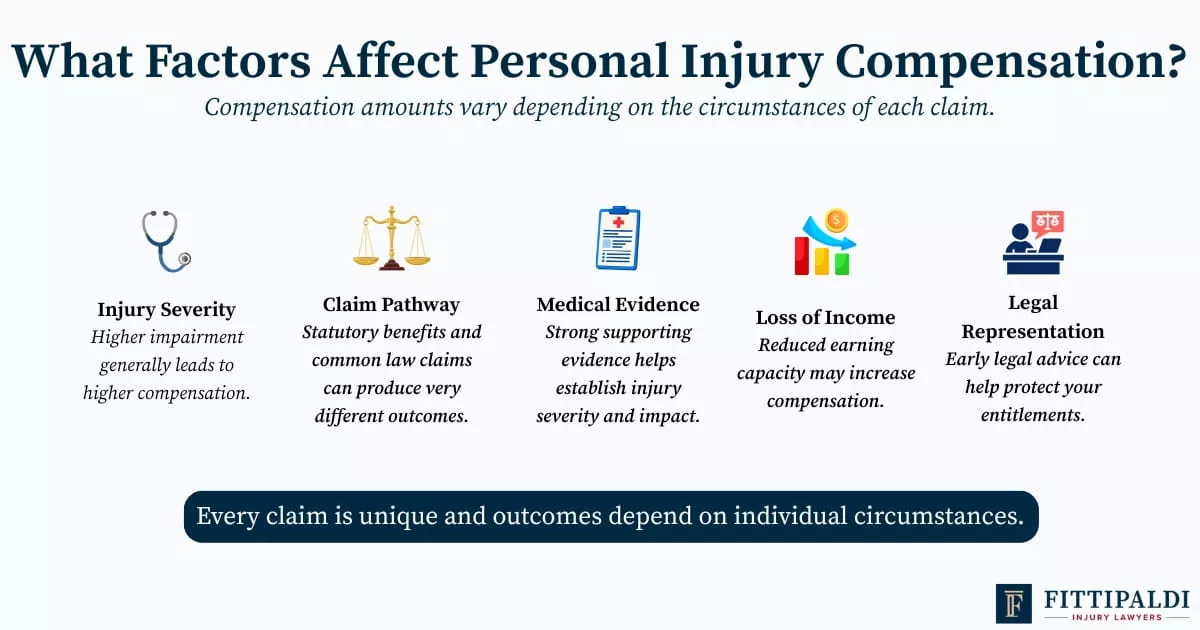
Injury Severity and Permanence
Which Pathway Your Claim Follows
Quality of Medical Evidence
Loss of Income and Future Earning Capacity
Legal Representation and Insurer Negotiation
How to Get an Accurate Estimate for Your Claim
The ranges in this guide are a starting point. They are not a promise, and they will not tell you what your specific claim is worth.
The most reliable way to get an accurate estimate is to have a case assessment by a senior lawyer who knows the Victorian schemes. At Fittipaldi Injury Lawyers, Gennaro personally reviews every new matter. There is no junior handoff.
Key Takeaways
- Personal injury payouts in Victoria range from a few thousand dollars to over $2 million, depending on claim type and injury severity.
- Most claims settle under statutory benefits, not common-law damages.
- Common-law access is limited but pays significantly more when the serious injury threshold is met.
- The TAC average across all claims is around $36,000; catastrophic brain and spinal injuries average $2.25 million.
- Averages are a starting point only. Your case specifics determine your actual outcome.
Legal Disclaimer
This article is general information only and does not constitute legal advice. Compensation amounts vary based on individual circumstances.
If you have been injured, seek independent legal advice specific to your situation.