


If you’ve been seriously hurt in a road accident in Melbourne or regional Victoria, these Transport Accident Commission (TAC) serious injury payout examples can help you know what compensation may be available and how much it could be.
These examples, however, cannot predict your own outcome. Compensation depends on your specific injuries, medical evidence, work capacity, treatment needs, and legal circumstances.
This article provides general information only. It is not legal advice.
- TAC provides no-fault statutory benefits to injured Victorians, regardless of who caused the accident.
- A separate serious injury and common law claim may be available where another party was at fault, potentially resulting in a lump sum for pain and suffering and economic loss.
- Every serious injury claim turns on its own facts. There is no reliable “average TAC payout,” and published case outcomes often reflect the most severe injuries, not typical results.
- This article uses anonymised, hypothetical examples only.
In This Guide
- What TAC Serious Injury Payout Examples Can and Cannot Tell You
- What May Be Considered a Serious Injury in Victoria
- Factors That Can Affect TAC Serious Injury Compensation
- Illustrative, Hypothetical Serious Injury Claim Scenarios
- How TAC and Common Law Damages Claims May Differ
- How Long a Serious Injury Claim May Take in Victoria
- When to Seek Legal Advice After a Melbourne Road Accident
- FAQs
- Getting Clear Advice on Your Own TAC Serious Injury Claim

What TAC Serious Injury Payout Examples Can and Cannot Tell You
Examples can be useful as a rough guide to how the system works, but they have limitations. Every serious injury claim depends on its own combination of facts:
- The type and severity of injuries sustained
- Your medical evidence and treatment history
- Your pre-injury work and earning capacity
- The circumstances of the accident itself
Most TAC common law settlements are confidential and not publicly available. Compensation amounts can vary significantly even for similar injuries, depending on the long-term impact on work and daily life.
What May Be Considered a Serious Injury in Victoria
TAC is Victoria’s no-fault road accident insurer. It covers people injured in motor vehicle accidents regardless of who was at fault. But to pursue common-law compensation, you first need to show that your injury meets the serious injury threshold under the Transport Accident Act 1986 (Vic).
There are two main pathways to meeting this threshold:
- 30% or more whole person impairment (WPI): If independent medical assessments confirm your permanent impairment is 30% WPI or above, you will automatically qualify.
A serious injury is defined as 30% or more impairment under the relevant guides.
- The narrative test: Even where WPI is below 30%, you may still qualify if your injuries involve serious long-term impairment or loss of a body function, permanent serious disfigurement, a severe long-term mental or behavioural disturbance, or loss of a foetus.
In determining what constitutes a serious injury, regard must be had to the ‘consequences’ of the impairment. Some injuries which have serious consequences include traumatic brain injuries, spinal cord injuries, amputations, severe burns, multiple fractures requiring surgery, and significant psychological injuries. Psychological injuries like post-traumatic stress disorder can qualify provided that there’s strong psychiatric evidence of long-term impact.
If you believe your injuries are serious, you can apply for a serious injury certificate, without which a common law claim cannot proceed. Your lawyer can apply to the County Court if TAC refuses.
Less severe but still permanent physical or psychological injuries may not meet the serious injury threshold. However, TAC may still fund medical treatment, rehabilitation, and limited income support under its no-fault scheme.
Factors That Can Affect TAC Serious Injury Compensation
- Type and extent of injuries. Both physical and psychological injuries. Accident-related injuries involving multiple injuries tend to produce higher assessments.
- Permanent impairment. The higher the assessed person’s impairment, the stronger the case.
- Age at time of accident. Younger individuals typically receive larger payouts due to decades of unfulfilled working lives and lost future earnings.
- Pre-injury occupation and income. A high-earning tradesperson who can no longer do heavy work may have greater past and future economic loss (loss of wages).
- Capacity to return to work. Whether you can return at all, in what capacity, and what lost wages result.
- Need for ongoing care, medical and like expenses. A poor medical prognosis allows for an argument for higher compensation.
- Quality of medical evidence. Evidence of complaints, consistent medical treatment, and thorough medical examinations make a significant difference.
A serious injury claim can include both pain and suffering and past and future economic loss. Pain and suffering damages consider factors like psychological trauma, loss of enjoyment of life, surgery, impact on relationships and day-to-day function, like affected sleep. Economic loss compensation accounts for wages lost from the 18-month anniversary of the accident through to retirement age.
Statutory caps apply to pain and suffering and economic loss in common-law claims.
From 1 July 2026, Victoria’s TAC transport accident scheme sets the common-law caps at A$701,620 for pain and suffering and A$1,578,760 for financial loss. The previous caps of A$680,160 and A$1,530,470 applied from 1 July 2025 to 30 June 2026.
The TAC estimates serious injury costs around A$2.25 million on average, but this reflects lifetime care and support rather than a common-law payout. While some common-law awards exceed A$1 million, and exceptional cases exceed A$2 million, there is no reliable evidence that spinal injury settlements typically reach that level.
For context on how compensation is assessed more broadly, see our guide on average payout for a personal injury claim in Melbourne.

Illustrative, Hypothetical Serious Injury Claim Scenarios
Scenario 1: Melbourne Tradesperson, Rear-End Collision
A 48-year-old electrician is rear-ended on the Monash Freeway. He sustains a spinal injury and a rotator cuff tear requiring surgery. Despite rehabilitation, he cannot return to heavy manual work and moves into a lighter administrative role at reduced pay.
His serious injury application focuses on permanent physical limitations and substantial economic loss over the remaining years to retirement. His claim includes pain and suffering damages and significant past and future economic loss.
Scenario 2: Young Cyclist, Car Dooring in Fitzroy
A 21-year-old university student is hit by a car door while cycling. She suffers multiple fractures and develops significant psychological injuries, including post-traumatic stress disorder. Her studies are delayed by two years, and her planned career start is pushed back.
Because her pre-injury income was minimal, the claim focuses on future earning capacity rather than large past loss. Medical evidence from treating specialists and psychiatrists is central to her serious injury application.
Scenario 3: Regional Office Worker, Psychological Injury After Witnessing a Fatal Crash
A 52-year-old office worker witnesses a fatal accident scene on a regional highway. His physical injuries are minor, but he develops severe PTSD and depression. He cannot return to work for over 18 months.
Psychiatric evidence is essential to meeting the serious injury threshold through the narrative test. His claim highlights the severe long-term mental disturbance and its impact on his person’s life, relationships, and capacity to work.
Scenario 4: Older Passenger Injured on a Bus
A 67-year-old part-time retail worker is injured as a passenger when a bus is involved in a collision. She sustains multiple fractures with slower recovery due to age and pre-existing conditions.
Her economic loss is more modest because of reduced work hours, but the impact on her independence and daily function is substantial. Her claim relies on the significant injury to her quality of life, need for home assistance, and ongoing medical expenses.
If any of these scenarios sound familiar, speaking with one of our TAC and road accident lawyers can help you understand how your own injuries and work situation may translate into a potential serious injury claim.
How TAC and Common Law Damages Claims May Differ
There are two main streams of support after a transport accident in Victoria, and they work differently.
TAC statutory benefits (no-fault) are available regardless of who caused the accident. They include:
- Payment of reasonable medical treatment and rehabilitation
- Some travel expenses related to treatment
- Weekly payments for lost income in certain circumstances
- Potential lump sum impairment benefits (for example, at 11% WPI or more)
A common-law claim is separate. It is a once-off lump sum for pain and suffering and, if applicable, past and future economic loss (loss of wages) compensation. To access common law compensation, you must satisfy the serious injury threshold and prove fault; that is, you must prove another driver or party was at fault.
To establish fault, you need to document how the other driver breached their duty of care and establish a direct link between the driver’s actions and your injuries. To understand what a personal injury claim involves, including how fault is assessed, it helps to get professional legal advice early.
Receiving a common law lump sum normally finalises your right to claim further damages for the same injuries, but TAC usually continues funding reasonable medical treatment and support services related to the accident. TAC manages the claim but acts as an insurer, not a personal advisor.
Statutory caps and thresholds exist in Victoria for both pain and suffering damages and economic loss. A lawyer can explain how these apply to your particular case, including the statutory maximum amounts.
How Long a Serious Injury Claim May Take in Victoria
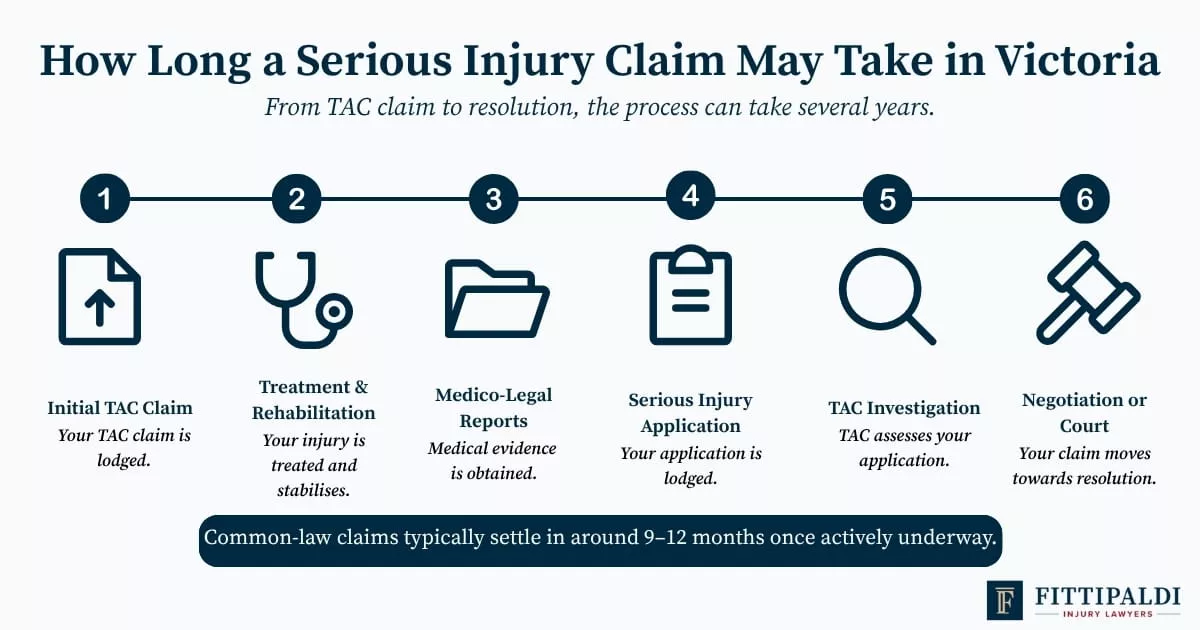
Serious injury claims take several years from the date of accident to final resolution, as a claim cannot be started until your injury is considered ‘stable.’
A typical timeline looks something like this:
- Initial TAC claim
- Treatment and rehabilitation
- Medico-legal reports
- Serious injury application
- TAC investigation
- Common law negotiations or court proceedings
The average settlement period once a common-law claim is actively underway is around 9-12 months, though delays can occur due to further surgery, changing work capacity, disputes about liability, or the need for additional specialist reports.
When to Seek Legal Advice After a Melbourne Road Accident
It is usually better to get advice early rather than waiting. Understanding your rights and the TAC process after a car accident in Melbourne is important and should be your first step.
Specific trigger points to seek legal assistance include:
- As soon as you’re involved in a serious car accident, regardless of fault
- TAC rejecting or reducing treatment approvals
- Difficulty returning to work or managing on reduced hours
- Long-term pain, psychological symptoms, or a diagnosis of permanent impairment
- Being told your injuries may be permanent
You must lodge your TAC claim within the required timeframe, and common law claims generally need to be commenced within six years of the accident (or six years from turning 18 for minors).
You need a lawyer to negotiate common-law compensation claims effectively. Engaging a lawyer can help maximise your compensation. Early in the process, you should also gather evidence like police reports and witness statements, as this material can be critical later.
An initial meeting with Fittipaldi Injury Lawyers involves a free case review, direct access to the lawyer who will run your claim, a clear discussion of strengths and risks, and an explanation of no-win, no-fee costs. The firm does not use litigation funders, meaning less comes out of any settlement and more stays in your pocket.
FAQs
Can I keep working while pursuing a TAC serious injury claim?
Yes, you can keep working while pursuing a TAC serious injury claim if you are able to. Many people return to modified or part-time duties while their claim proceeds. Continuing to work does not automatically stop you from claiming common law damages.
What happens if TAC refuses to grant a Serious Injury Certificate?
If TAC refuses to grant a Serious Injury Certificate, your lawyer can review TAC’s reasons, obtain further medical evidence or factual evidence, and consider issuing court proceedings. An experienced TAC lawyer can prepare a strong serious injury application and guide you through any court process, including settlement opportunities along the way.
Will a common-law lump sum affect my Centrelink or other benefits?
A common-law lump sum may affect your Centrelink payments or other government benefits. If the settlement includes compensation for loss of wages, Centrelink may apply a preclusion period and may recover certain income-support payments you received before settlement. The effect depends on the type of common law payment you receive and the circumstances of your settlement.
Fittipaldi Injury Lawyers can identify potential Centrelink implications during the claims process so you have time to seek appropriate financial advice before settlement.
Getting Clear Advice on Your Own TAC Serious Injury Claim
TAC serious injury payout examples can help you understand how injury claims work, but they cannot predict what your own claim might look like.
Fittipaldi Injury Lawyers offers direct access to the lawyer managing your file, honest, transparent advice about your claim’s strengths and risks, face-to-face strategy meetings where appropriate, and no-win, no-fee representation without litigation funders.
If you have been injured in a transport accident in Melbourne or anywhere in Victoria, contact Fittipaldi Injury Lawyers for a free case review to discuss your next steps and whether a serious injury or common law claim might be available to you.